Talking Rome, 50Ks and Doing Hard Things with the Daily Stoic’s Ryan Holiday
A while back I was invited to talk with Ryan Holiday of The Daily Stoic as he was planning his first 50K.
For anyone not familiar with Ryan Holiday, he is the #1 New York Times bestselling author behind books including The Obstacle Is the Way, Ego Is the Enemy, Stillness Is the Key and The Daily Stoic. His books have now sold more than 10 million copies, and his work has become one of the most visible modern introductions to Stoic philosophy. He launched The Daily Stoic as an email in 2016 and the podcast followed in August 2018.
Since then, the podcast has grown to more than 150 million lifetime downloads and, according to Ryan, averages around 5 million downloads a month. The broader Daily Stoic audience is even larger: roughly 1 million email subscribers, 2 million YouTube subscribers, and millions more across Instagram, TikTok and other social platforms. The podcast now has well over 2,000 episodes and mixes short daily Stoic lessons with longer conversations with people ranging from Matthew McConaughey and Malcolm Gladwell to athletes, military leaders and entrepreneurs.
Ryan already had the idea for the run. He was going to Rome and wanted to put together a 50K route through the city, connecting some of the places associated with the Stoics. While researching the trip, he came across my article about my own 53K run into Rome along ancient Roman roads and the Via Francigena.
That is one of the things I like about keeping UltraRunning Destinations going. Some of the trips on this site happened years ago, but the trails, roads and ideas are still there for someone else to discover and turn into their own adventure.
Ryan reached out and we ended up talking for about an hour. I really liked what he had planned. It wasn't an organized race and there wasn't a finish-line arch waiting for him. He had picked a distance, built a route around places that interested him and was going to see if he could do it.
We talked about training, carrying gear, food, heat, the roads around Rome and what happens when a route that looks perfectly reasonable on a map turns out to be something completely different once you get there. We also spent quite a bit of time talking about why someone would want to do these things in the first place.
Ryan turned part of our conversation into a bonus podcast episode, The Advice Ryan Got Before Running His First 50K, for the main show Running 50 Kilometers Through Rome To Understand Stoicism.
Ryan also made a video of the actual run on YouTube. Watching it brought back quite a few memories from my own trip. My run started outside Rome near Frascati at the edge of Parco dei Castelli Romani. From there I ran through the park before eventually connecting with the Via Francigena and following it toward the center of Rome.
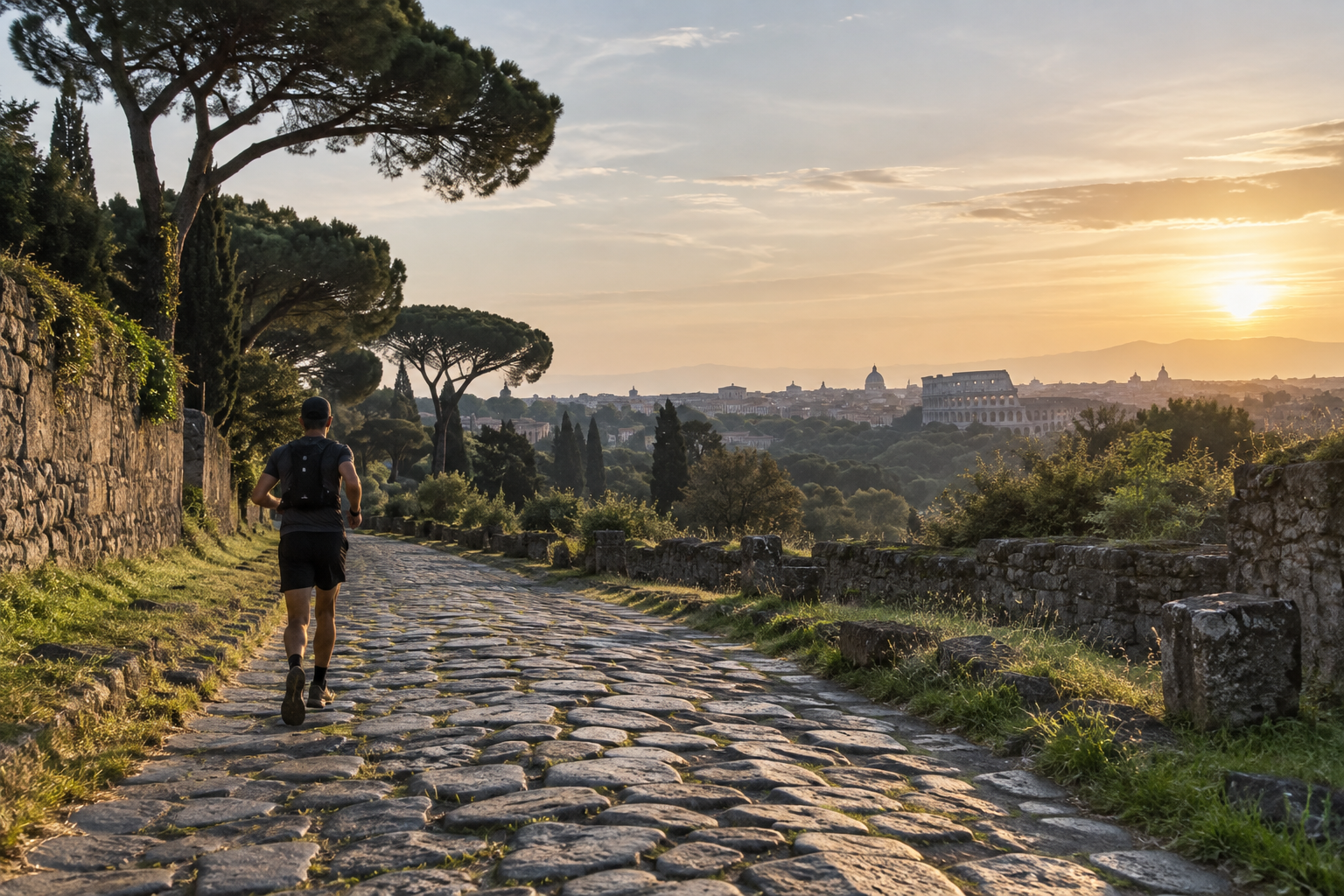
One of my favorite parts of my run was running on the old Roman roads. There are places where you're moving across huge stones that have been there for an almost ridiculous amount of time. You can see the wear in them and think about all the people who traveled the same route hundreds or even thousands of years before you.
Later in the day, after roughly 50 kilometers of trails, old roads, rain and a few miles of fairly unpleasant running next to traffic, I suddenly came into Rome and found myself looking at the Colosseum.
I get emails and messages from people fairly regularly who have found one of the trips on this site and are thinking about doing something similar. I enjoy those conversations. The goal was never that somebody would reproduce one of my routes exactly. Hopefully the information gives them enough confidence and a few ideas to create a trip of their own. It's great seeing how much adventuring people are doing.
Most of our lives are designed to remove inconvenience. Running 50 kilometers does the opposite. Eventually something hurts, the weather changes, the route isn't what you expected or you simply get tired. At that point there isn't much to negotiate with. You keep moving and deal with the problem in front of you. Strangely enough, those are often the days you remember most. Maybe that is part of the satisfaction of doing hard things. For a few hours, the objective becomes very simple.